
Radhika Shah didn't wait for impact investing to become fashionable she was architecting the bridge between Silicon Valley capital and the Global South's development priorities decades before applause arrived. A Stanford-trained technologist turned angel investor, she co-authored peer-reviewed research proving that bias, not just access, keeps capital from reaching who deserves it. Meet a Challenger built on presence, not headlines.
 Rashmeet Kaur Chawla
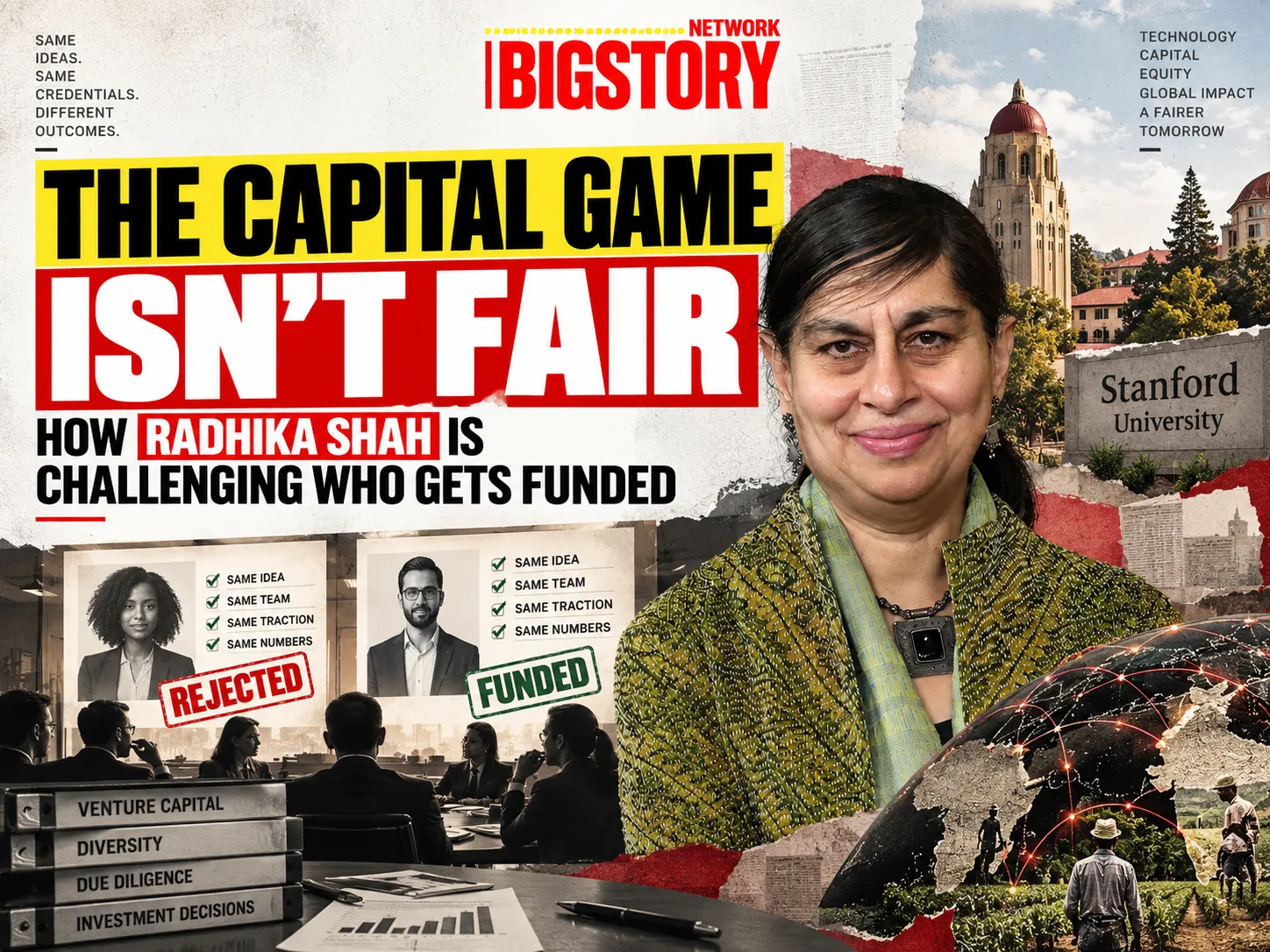
There is a version of "impact investing" that shows up on conference stages every year with a new name, a new acronym, and the same recycled promises. Radhika Shah is not that version. She is a Challenger because she was doing the work architecting technology, sitting on boards, writing research papers on bias in capital allocation years before "impact" became a line item on a pitch deck. She built bridges between Silicon Valley's capital and the Global South's development priorities when there was no applause waiting on the other side, and she is still building them, one advisory seat at a time.
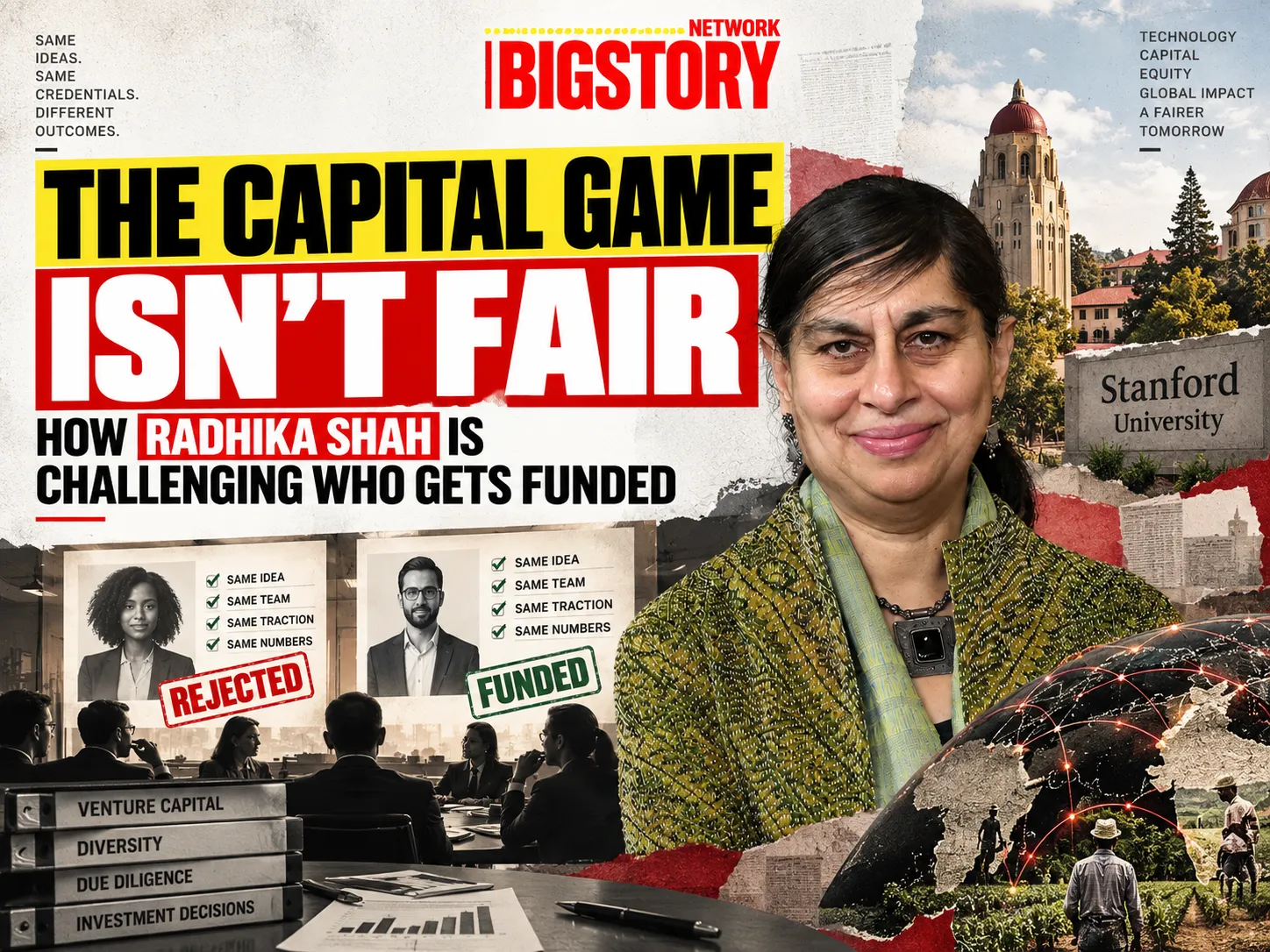
Of the $69.1 trillion in global financial assets under management across mutual funds, hedge funds, real estate, and private equity, fewer than 1.3% is managed by women and people of color. That is not a pipeline problem alone it is a judgment problem. Radhika Shah co-authored with Stanford SPARQ and Illumen Capital, published in the Proceedings of the National Academy of Sciences, found that professional asset allocators rated white-led investment teams more favorably than Black-led teams with identical credentials and the bias grew stronger, not weaker, as the Black-led teams' performance improved. In other words, proving yourself sometimes worked against you.
That single finding reframes everything else Radhika has spent her career doing. The problem was never a shortage of capital or a shortage of capable people on the ground in Nairobi, Bangalore, or Oakland. The problem was the invisible architecture of how decisions about that capital get made and almost nobody was willing to sit in the rooms long enough to rebuild it.
Radhika Shah is an angel and impact investor, technologist, and civic-bridge-builder based in Silicon Valley, and Co-President of Stanford Angels & Entrepreneurs, a community of roughly 1,200 entrepreneurial Stanford students, faculty, and alumni. She holds a Master's in Computer Science from Stanford University and an MBA from UC Berkeley's Haas School of Business, a combination that let her speak fluently in both the language of product architecture and the language of capital markets long before "impact investing" existed as a career track.
Her career did not begin with a checkbook. It began with code.
Shah's current footprint reads like a map of where technology, capital, and human rights are forced to negotiate with each other. She serves on the board of the Center for Effective Global Action (CEGA) at UC Berkeley, which brings mission-driven academics from across departments and the West Coast's top universities into applied research on poverty and development. She is an advisor to the Sustainable Development Goals Philanthropy Platform and Founding Chair of its Tech Advisory Board, a Fellow at Stanford's Handa Center, and a member of the International Advisory Network of the Business and Human Rights Resource Centre, where she also helped found its Tech Advisory Board. She advises the Kenya SDG Accelerator Lab and sits on the Silicon Valley Leadership Council for Action for India, a Delhi-based group that helps social entrepreneurs scale.
She has also been an advisor, mentor, and judge at innovation accelerators including StartX at Stanford and SkyDeck at UC Berkeley, and has judged the U.S. Small Business Administration's national Growth Accelerator competition evaluating, year after year, which early-stage founders deserve a shot at capital.
Most people in Radhika's orbit are fluent in one language: either the fast-iteration, results-obsessed dialect of Silicon Valley, or the consensus-driven, equity-first dialect of the development world. Shah is fluent in both, and more importantly she is willing to do the work of translating between them. That translation shows up in her co-authored op-eds with development economists like Dr. Temina Madon, arguing that the UN's "decade of action" needs to be matched with disruptive, on-the-ground innovation in places like Kenya, not just declarations at headquarters. It shows up in her essay with Phil Bloomer for Stanford Social Innovation Review, which argues that the shift to renewable energy cannot be separated from human rights because technology and capital are only tools, and tools do not have a conscience of their own.
Her capability is not any single skill. It is presence showing up on the same boards, the same panels, the same working groups, year after year, until the translation between two worlds stops needing an interpreter.
Shah's authenticity is not a branding choice; it is biography. She grew up in the shadow of the Gandhi Ashram, raised by a grandfather who was an intellectual leader of Gandhian thought a childhood that wired civic engagement and social responsibility into her worldview before she ever wrote a line of code.
That code came first, professionally. In the early days of the commercial internet, Shah worked as a technologist and entrepreneur in information retrieval and social networking, where she helped architect some of the earliest personalization and online-community solutions at BroadVision. From there, her career moved through Silicon Valley's engine room security and enterprise roles at Sun Microsystems, SGI, and Oracle's security group, then into product leadership at GreenBorder Technologies, before co-founding Virtual Synaptics as its VP of Products and Business Development. She built things and sold things long before she started advising on which things deserved to be built.
The hardest problem she keeps running into is not a single crisis it is a structural one that never fully resolves. Every time she sits on an accelerator's evaluation panel, she confronts the built-in tension between what will generate returns and what will generate genuine social good, knowing the two do not always point in the same direction.
Her work with Illumen Capital forced her to confront an even harder truth: capital allocation, the thing the entire industry insists is rational and merit-based, is measurably shaped by unconscious racial bias bias that gets worse, not better, as the evidence of competence piles up.
There is no accelerator program or single fund that fixes that. It requires exactly the kind of unglamorous, repeated, multi-year presence that doesn't photograph well for a press release advisory calls, board meetings, co-authored papers, panel after panel done specifically because they are tedious, not despite it.
Talking about her achievement is not a single fund, a single exit, or a single headline and that is precisely the point. What she has built is infrastructure: a dense, durable network of boards, advisory groups, and accelerators that did not exist as a connected system before people like her insisted on treating "impact" as plumbing rather than marketing. The PNAS research she co-authored turned an open secret that bias shapes who gets funded into peer-reviewed, citable evidence that the industry can no longer wave away. That is a goal most investors never even attempt, let alone reach.
Artificial intelligence meets global development a space she has been actively shaping through forums like the Stanford Alumni Alliance on Innovation for Global Impact, co-convened with the Stanford King Center on Global Development, United Nations University, and SDG Impact Japan, where she has moderated fireside conversations between figures like Andrew Ng and Desh Deshpande on AI's role in tackling major social challenges. The next chapter of her bridge-building is not just about who gets capital, but about who gets a seat at the table as AI reshapes what "impact" and "investment" even mean.
It's not just because they've set the most records. It's because they rejected the notion that we can't have both that our two worlds must remain forever split between the poles of capital and conscience, between Silicon Valley and the Global South, between technology and human rights.
Radhika Shah is a Challenger because she didn't wait until impact investing became cool to do it. She built the bridge before anyone decided it was necessary, and she keeps making it wider with every advisory seat she accepts.
● Before she was an "impact investor," Shah spent nearly two decades in enterprise technology including stints at Sun Microsystems, SGI, and Oracle's security division building the unglamorous infrastructure layer of the early internet.
● She co-founded VirtualSynaptics, a startup focused on application virtualization and sandboxing, as its VP of Products and Business Development, before pivoting fully toward social impact.
● She is a published academic co-author: her name sits alongside Stanford psychologist Jennifer L. Eberhardt on the PNAS paper "Race Influences Professional Investors' Financial Judgments" a study now cited across the impact-investing field as hard evidence that bias, not just access, blocks diverse fund managers.
● She co-founded the former Ashoka Silicon Valley chapter and spent two years personally connecting Ashoka Fellows grassroots social entrepreneurs from around the world with Silicon Valley's capital and mentorship networks.
● She is a founding volunteer of RajeevCircle.org, a roughly 400-member Silicon Valley mentoring community founded in memory of Stanford professor Rajeev Motwani, built to continue his ethic of helping others without expecting anything back.
● She sits on the Steering Committee for the Stanford Refugee Research Project a corner of her portfolio that rarely makes it into her public bio, but reflects the same instinct: show up where the capital and the attention are thinnest.
● She advises social-entrepreneur-led nonprofits including Healing Fields, CGNet Swara, and Samasource organizations working on healthcare access, rural journalism, and inclusive digital work respectively.
We chose to profile Radhika Shah not because she has a dramatic founder's origin story, but because she embodies the one quality the impact-investing space is chronically short on: patience.
In an industry obsessed with exits and headline valuations, Radhika has spent decades doing the tedious, necessary work sitting on boards, advising founders, co-authoring research, showing up to the same rooms again and again to make sure capital actually reaches the people it claims to serve.
That is not a single achievement. It is a discipline. And it is exactly why she is a Challenger, not because of one exit or one headline, but because of a lifelong commitment to action over intent.
 Exclusive Content




Sign up for the Daily newsletter to get your biggest stories, handpicked for you each day.



 Trending Now! in last 24hrs